Project Launch
Sustainable Traffic Management Systems
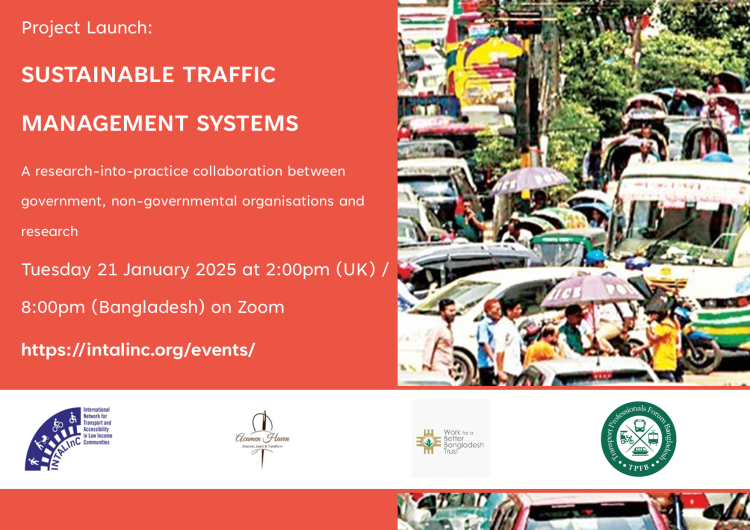
Led by Sharmin Nasrin (Arizona State University) in collaboration with INTALInC, Acumen Haven, Work for a Better Bangladesh and the Transport Professionals’ Forum Bangladesh, this webinar provides an overview of a new project, Sustainable Traffic Management Systems. It is also an opportunity for you to help shape the project and contribute to more equitable public transport in Bangladesh.
Traffic congestion is a major challenge in Bangladesh, disproportionately affecting the everyday lives of low-income people. For those who rely on legunas, buses, and other affordable transport options to get around, congestion has a direct impact on time, money, health, and quality of life. Public transport stuck in traffic delays and extends journey times for passengers, while pedestrians are exposed to traffic fumes and forced to navigate dangerous road conditions. For drivers, many of whom come from similarly low-income backgrounds, congestion limits opportunities to improve their livelihoods.
Join INTALInC and partners on Tuesday 21 January 2025 at 2:00pm (UK) / 8:00pm (Bangladesh) to help shape this new, research-into-practice collaborative project. With an introductory presentation from Sharmin Nasrin (Arizona State University), and an interactive panel chaired by Jim Walker (Walk21), learn about and contribute to a project that brings together low-income groups with traffic police to develop an innovative, self-funding model aiming to improve public trust in government agencies and support the redevelopment of traffic infrastructure in Bangladesh for everyone’s benefit.
4th Annual Seminar Series
Decolonising transport planning – what are the implications for transport poverty?
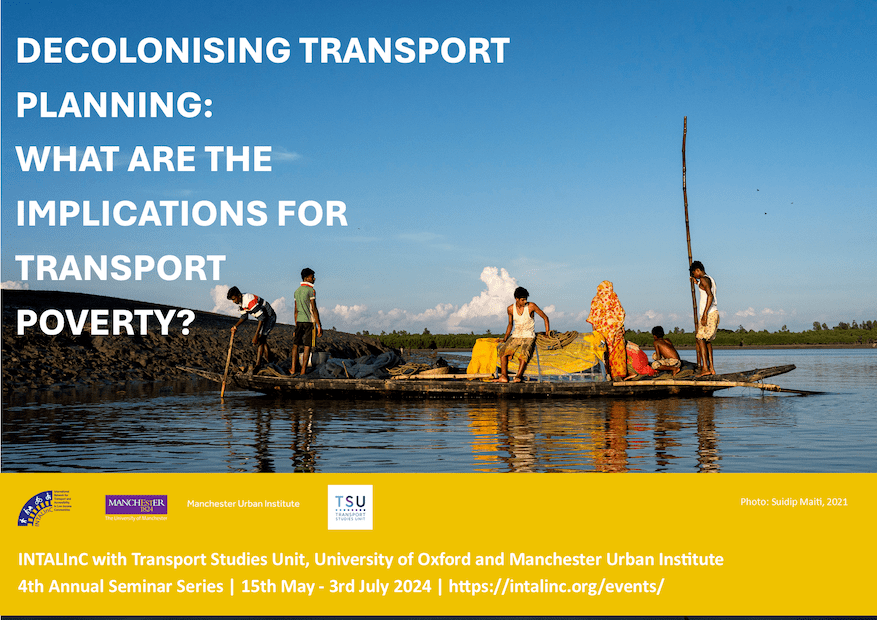
In collaboration with Transport Studies Unit, University of Oxford and Manchester Urban Institute, the fourth INTALInC annual seminar series will run from Wednesday 15th May 2024 to Wednesday 3rd July 2024.
Thinking on transport in academic research and policy across the planet has long been ground in Western ideas and ideals of science and knowledge. This is also true for much transport research conducted on and in countries and regions that have historically been subjected to European and Western colonialisms in Africa, Asia, the Americas and Oceania. Recently there have been multiple calls and some attempts to ‘decolonise’ transport research, typically informed by discussions on the creation and circulation of decolonial knowledges in disciplines such as geography, sociology and political science. Yet much remains unclear about how transport research can be best decolonised, and what this means for the concepts, frameworks, methods and research practices that are habitually used in transport research. One area of transport research that may particularly benefit from decolonial thinking is that on transport disadvantage, transport-related social exclusion and transport justice. This seminar series critically examines the potentials and limitations of decolonial approaches to transport disadvantage, exclusion and justice. It will cover a wide range of issues but pay particular attention to questions around informal or popular transport and the gendered nature of travel, mobility and transport systems.
Wednesday 15th May 2024
Decolonisation: Why is it important for transport poverty?
Chair: Professor Karen Lucas, University of Manchester.
Speakers: Dr Astrid Wood, Newcastle University; Dr Lela Rekhviashvili, Leibniz Institute for Regional Geography; Professor SG Odewumi, Lagos State University.
This first session will introduce different ways in which working towards a decolonial approach to transport research may inform transport planning in the global south. Many attempts to work towards decolonial transport research have been undertaken by scholars based in the global north. They rest on the argument that use of Euro-American approaches to transport planning is problematic in southern contexts, because these approaches render many local knowledges invisible and frequently misunderstand the nature and evolution of transport systems and behaviour across Africa, Asia, and Latin America and the Caribbean. Their aim is to inspire a shift towards more contextually appropriate and socially inclusive mobility regimes, which requires a move away from Euro-American knowledge about transport systems and the radical redefinition of what constitutes sustainable transport for low and middle-income countries. In this session, we aim to explore the potential implications of this emerging research agenda for addressing current and newly emerging transport inequalities across Africa, Asia, and Latin American and the Caribbean.
Wednesday 29th May 2024 from 2:30pm – 4:00pm (UK time)
Decolonisation and popular transport
Chair: Tim Schwanen, University of Oxford.
Discussant: Benjamin de la Peña, Shared Mobility Center.
Speakers: Dr Bradley Rink, University of Western Cape; Dr Sandy Mae Gaspay, University of the Philippines.
In this second session, we discuss the appropriateness of western and increasingly Chinese ways of thinking about, and models of, public transport provision for addressing the unmet mobility needs of transport poor populations. The informal nature of public transport in many global south cities is largely viewed as inefficient and inappropriate for the modernising agenda of world cities. Much of the neo-colonisation of public transport planning therefore comes in the form of modern-looking, high-tech and often large-scale infrastructure projects that are funded and designed by global agencies external to the countries in which they are being developed. In many instances, such projects exacerbate rather than alleviate transport inequalities in the cities where they are introduced. Even when their design is purposefully inclusive, their operation is limited to specific corridors and usually does not reach low-income, peripheral communities. We will also consider ways of improving service provision, safety and labour relations that emerge from within the popular transport sector and through authorities working with that sector.
Wednesday 12th June 2024 from 2:30pm – 4:00pm (UK time)
Marginalisation, gender and decolonisation
Chair: Karen Lucas, University of Manchester.
Speakers: Dr Daniel Muñoz, Universidad de Chile; Winnie Sambu, World Bicycle Relief;
Dr Eda Beyazit, University of the West of England.
In this session we will reflect on ways in which decolonial thinking opens up new ways in which different forms of mobility-related disadvantage can be worked around and addressed in context-sensitive and often creative ways. The existence of mobility-related disparities is universal but the particular forms they take cannot be understood without paying due attention to local contexts and the gendered and otherwise differentiated practices through which mobility is planned, provided and appropriated by particular individuals, groups and communities. On the one hand, this means that standardised, global and high-tech solutions often do not overcome mobility-related disadvantages in the manner that was expected when they are implemented. On the other hand, it also implies that paying detailed attention to local contexts and mobility practices can foreground the precise, flexible and creative ways in which individuals and communities in particular localities work around and reduce mobility-related inequalities and thereby compensate for the structural disparities that are grounded in gender, dis/ability, class and/or ethnicity and wired into cities across the planet.
Wednesday 3rd July 2024 from 2:30pm – 4:00pm (UK time)
Panel: Decolonising transport planning
Chair: Tim Schwanen, University of Oxford
Panellists: Professor SG Odewumi, Lagos State University; Professor Winnie Mitullah, University of Nairobi; Professor Gina Porter, University of Durham; Dr Daniel Oviedo, UCL.
In the final session of this year’s webinar series, we bring together an international panel of experts across a range of transport-related disciplines to discuss what a decolonised transport agenda would look like in the context of their own national perspectives and experiences from working within the global south. They will reflect upon how more locally appropriate policy and planning models might be used to redirect transport resources towards solutions that purposefully reduce transport poverty and inequalities across the different regions of the global south. They will also discuss what more is needed to engage policymakers and planners in these discourses.
Professional training
Methods Masterclasses
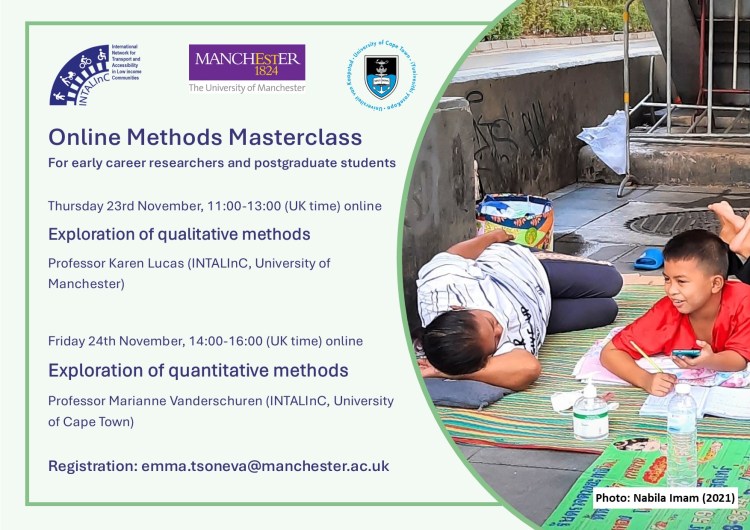
INTALInC and partners at the University of Manchester and the University of Cape Town will present two mixed methods masterclasses for early career researchers and postgraduate students working in the fields of transport and mobilities.
The masterclass will be delivered in two online interactive 2-hour sessions: Exploration of Qualitative Methods on 23rd November 2023 led by Karen Lucas (INTALInC, University of Manchester), and Exploration of Quantitative Methods on 24th November 2023 led by Marianne Vanderschuren (INTALInC, University of Cape Town). The sessions are free to access and will be delivered over Zoom.
Both sessions are designed to be as open and interactive as possible. Participants are invited to bring examples from their own work for exploration and discussion. The masterclass offers researchers the chance to explore and critically reflect on key concepts in methodology, and think about the ways in which these can be applied to their own work.
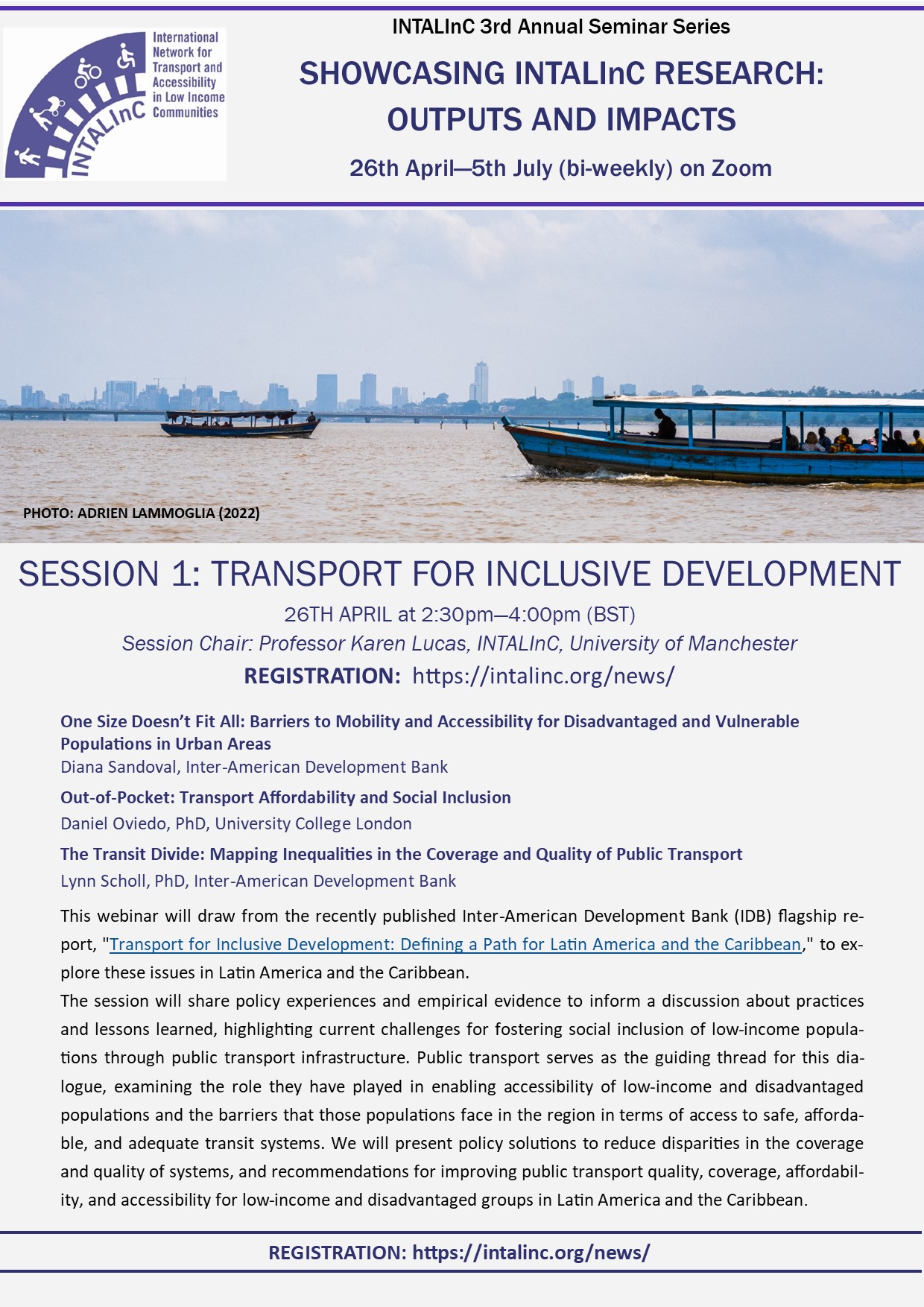
Third annual international INTALInC webinar series
Showcasing INTALInC research: Outputs and impacts
ALL SESSIONS OF THIS SERIES ARE NOW AVAILABLE TO WATCH ON YOUTUBE
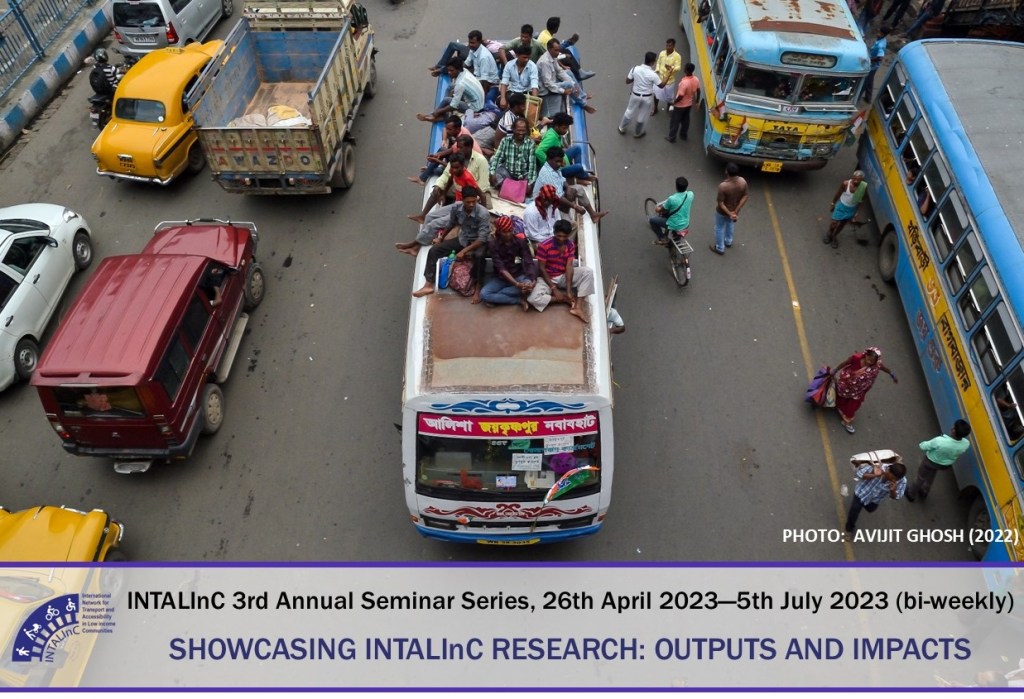
After six years of global research activity, policy engagement and co-production with local communities to understand their mobility and accessibility needs, this seminar series will promote our publications, guidance documents and other research outputs.
This is a chance to hear from some of the many projects and programmes that have been promoted under the INTALInC banner. The series showcases work from Inter-American
Development Bank, University of Manchester, SEI Africa and SEI York, Istanbul Technical University, World Bicycle Relief, and culminates in a final panel session.
Wednesday 26th April 2023 at 2:30pm (BST)
Session 1: Transport for inclusive development
Chair: Karen Lucas (INTALInC); Presenters: Lynn Scholl and Diana Sandoval (Inter-American Development Bank), Daniel Oviedo (University College, London)
Thursday 11th May 2023 at 12:00pm (BST)
Session 2: Intersectionalities between transport and social inequality in India and Bangladesh
Chair: Ajay Bailey (Utrecht University); Presenters: EQUIMOB
In this session, we present results from the EQUIMOB project where we explore how physical and social barriers to urban transport are widened by the existing infrastructures and the impact these inequalities have on the marginalized and vulnerable populations of the Global South, namely women, people with disabilities and older adults. Using examples from cities of India and Bangladesh, we present cases of women moto-commuters performing gender and respectability on two-wheelers within the urban patriarchal structures of Dhaka. We also look at urban traffic congestion and its impact on the health of older adults and wheelchair users in Dhaka. Finally, the session will discuss the barriers to first and last-mile connectivity for women in Kolkata.
Wednesday 31st May 2023 at 2:30pm (BST)
Session 3: Health and wellbeing interactions on mobility in East African cities
Chair: Steve Cinderby (SEI York); Presenters: Cassilde Muhoza, Romanus Otieno Opiyo (SEI Africa); Constant Cap (Urban planner and researcher); Shermyne Omangi (Urban planner and researcher); Nancy Abira (Transport engineer); and Rachel Pateman (Ecologist)
Wednesday 7th June 2023 at 2:30pm (BST)
Session 4: A gender-responsive transport policy in the global south
Chair: Eda Beyazit (Istanbul Technical University). Presenters: Beatriz Mella Lira (Universidad Andres Bello, Chile); Tanu Priya Uteng (Norwegian Centre for Transport Research); Sharmin Nasrin (Presidency University, Bangladesh)
Wednesday 21st June 2023 at 2:30pm (BST)
Session 5: Bicycles for growth
Presenters: Gail Jennings, Winnie Sambu and Alisha Myers (World Bicycle Relief)
Wednesday 5th July 2023 at 2:30pm (BST)
Session 6: Emerging priorities for future research
Bringing presenters from across the series together for a panel discussion chaired by Karen Lucas (INTALInC). The session will focus on two key questions which have emerged from presentations and Q&A sessions, namely:
- How should we communicate evidence to people with the power to make a difference in a way that provokes the response these populations need?
- Given the extent of the research and evidence base, what needs to be done next to improve transport and mobilities for vulnerable populations in the Global South; and
Panel members include Daniel Oviedo (University College, London); Steve Cinderby (SEI York); Eda Beyazit (Istanbul Technical University); Tanu Priya Uteng (Norwegian Centre for Transport Research); Nancy Abira (SEI Africa); and others TBC.

Second annual interactive INTALInC webinar series:
Solutions-led perspectives on sustainable and inclusive transport and mobilities: New pathways, fresh horizons
This event ran in 2022.
The second INTALInC international webinar series ‘Solutions-led perspectives on sustainable and inclusive transport and mobilities’ offered fresh insights into emergent practical approaches to facilitate the complex mobilities and accessibilities of low income settlements and vulnerable populations as they intersect with transport and urban planning, socio-economic inequalities, informalities and sustainability transitions.
Six interactive sessions investigated themes including: ‘New Perspectives from Emerging Horizons’; ”Inclusifying’ Urban Transport’; ‘Participative Solutions in Urban Transport Planning’; ‘Digital Futures and the Role of Technologies’; and ‘Spatial Planning and Integrated Transport Development’ to identify and explore solutions to meet needs on the ground. To conclude, a panel session brought together ideas and experiences from across the series to look at ways of ‘Bridging the Gap between Policy and Practice’.
The series brings together some of the most exciting speakers working on transport and mobilities research, policy and practice in academia, planning, governance, and activism from around the world. Contributors include experts from INTALInC and INTALInC LAC; University of Cape Coast; University College, London; Walk21; Stockholm Environment Institute; Code for Africa; Transport Studies Unit, University of Oxford; Norwegian Centre for Transport Research; University of Asia Pacific; Manchester Metropolitan University; and CEDEUS.
Early Career Researchers’ Showcase
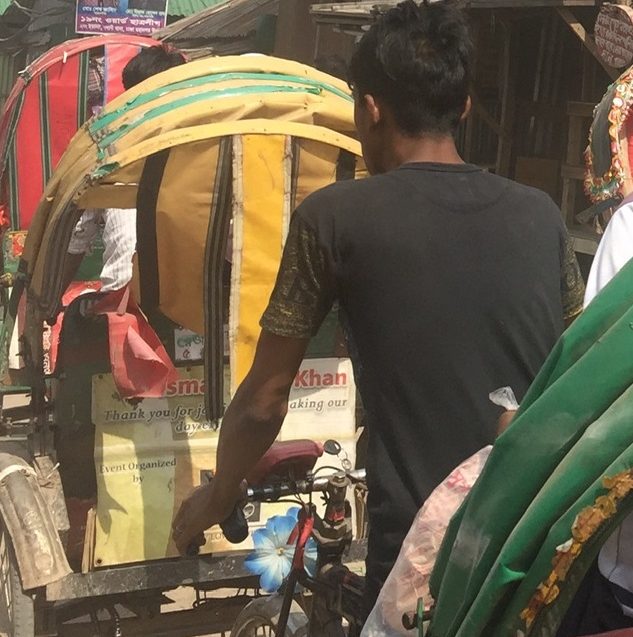
INTALInC is hosting an online seminar to showcase the work of our Early Career Researchers on Thursday 8 April 2021 from 2:00pm to 4:30pm (UK time). The event is open for all network members and will be a great opportunity to hear emerging opinions about transport justice and equitable mobility in the global south.
Presentations all focus on transport, mobility and accessibility in urban environments, and correspond to one of the following themes:
- Low income communities and informal settlements;
- Disadvantaged and vulnerable groups;
- Access to livelihoods, health and wellbeing;
- Walking, cycling, NMT and paratransit.
Webinar series
The broad topic of transport-related social exclusion in different geographical contexts has gained a lot of traction over the last few years, increasingly with a focus on meeting the needs of low income settlements and vulnerable populations in African, Asian and Latin American cities. Researchers from various disciplines are investigating how mobility and accessibility intertwine with complex issues of transport and urban planning, informality, social, economic and health inequalities, and sustainability transitions. Yet there remains multiple theoretical, methodological, conceptual and practical challenges to achieving urban transport systems that meet the travel needs of vulnerable populations in most global south cities.
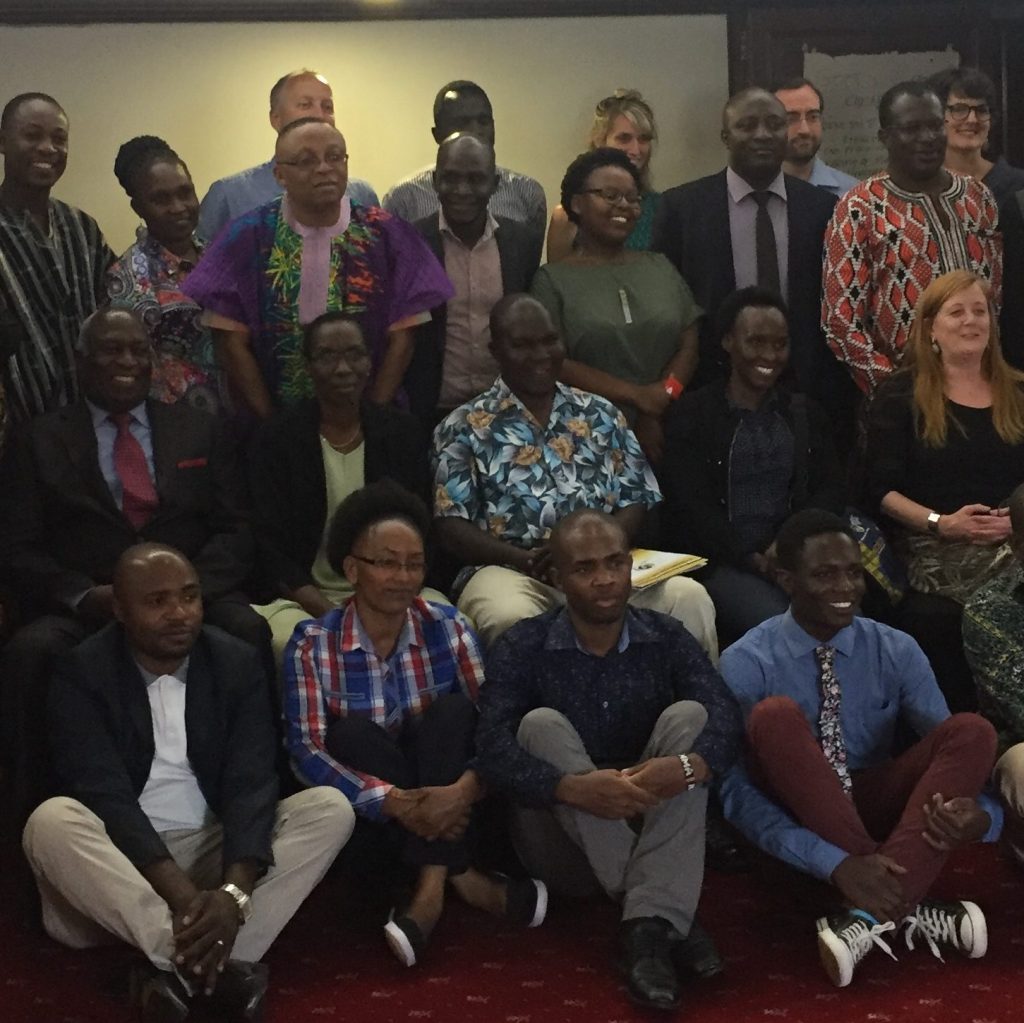
The webinar series brought together an international community of established and early career scholars working in the diverse and vibrant research domain to share their recent work and experiences, and to reflect on the key challenges and opportunities we face under six themes:
- Access to opportunities;
- Informality;
- Transitions;
- Health;
- Gender; and
- Age
Click here to view the full series programme, and here to watch recordings of the presentations.
 INTALInC